Production process · Microsite
The cacao production process, step by step
A second booklet that follows the cacao production process in five short steps, each with its own picture, from the plant to the cup, within the same sustainable agritourism route.
From the tree to the cup
Step 1
The plant
Growing the cacao tree.
3 words in the glossary: The plantStep 2
Harvest
Picking and opening the pods.
1 word in the glossary: HarvestStep 3
Post-harvest
Fermenting and drying the beans.
10 words in the glossary: Post-harvestStep 4
Bean to bar
From dry beans to chocolate.
9 words in the glossary: Bean to barStep 5
The visit
Experiencing it on the farm.
10 words in the glossary: The visit
Reading aloud is not available in this browser.
Page 1 of 10

The plant
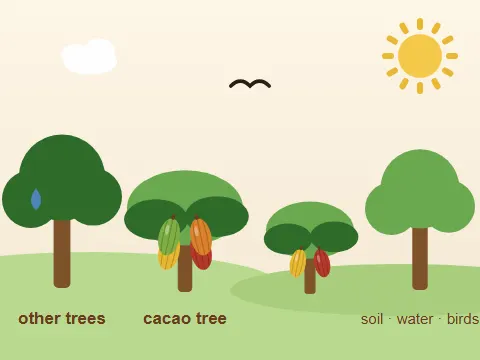
Cacao is grown together with other trees and plants: an agroforestry system. It helps the soil, the water and the birds.
Farmers keep their best trees by grafting, joining a piece of one plant to another, or with clones, copies of a mother plant. Here, farmers call the pod pepino.
Harvest
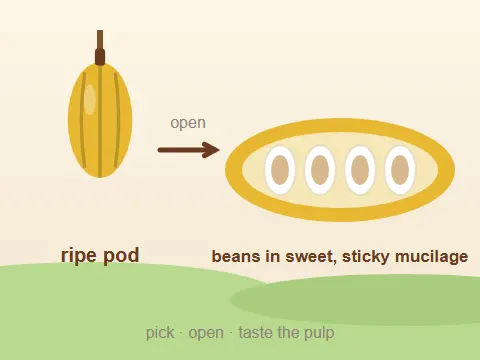
Farmers pick the ripe pods and open them. Inside, the beans are covered with a sweet, sticky white pulp called mucilage. It can be eaten fresh, and later it feeds fermentation.
A pod ripens in two ways: from green to yellow, or from purple to red.

Post-harvest
After harvest comes post-harvest processing: fermentation and drying.
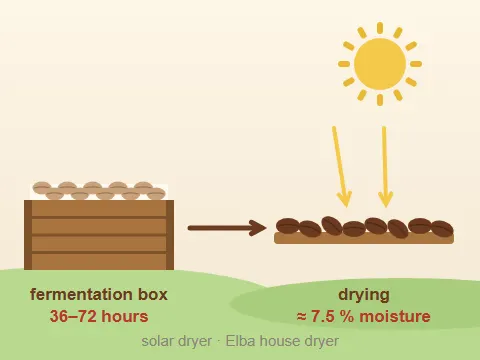
The beans rest in a fermentation box for 36 to 72 hours. Tiny living things break down the pulp and create the flavor of chocolate.
Then the beans are dried until they have about 7.5 % moisture, in a solar dryer or an Elba house dryer with a sliding roof for the rain.
Bean to bar
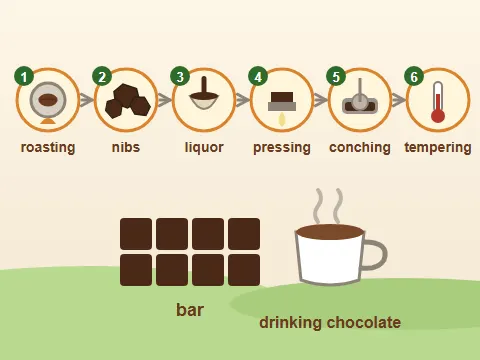
Roasting brings out the flavor. Then come cacao nibs, small pieces of the bean.
Grinding the nibs makes cocoa liquor, a paste with no alcohol. Pressing separates cocoa butter from the cocoa cake, which becomes powder.
Conching is a long, slow mixing. Tempering heats and cools the chocolate so it is shiny and snaps.

The visit
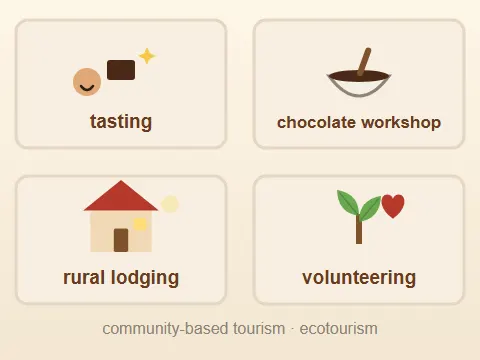
Agritourism means visiting a farm to learn about farming and rural life. Visitors can join a tasting and a chocolate workshop, stay in rural lodging, or volunteer.
Community-based tourism keeps the benefits in the community. Ecotourism protects nature. San Vicente de Chucurí is known as the cacao capital.
Where it happens
San Vicente de Chucurí, Santander
Known as the “Capital Cacaotera de Colombia”.
Nature
Cueva de los Aviones
A cave with two water sources and seven pools. It is named after the bird that lives in it.
Parque Natural Miraflores
A natural park listed among the municipality's attractions.
Salto del Caracolí
A waterfall of about 30 meters, with a natural pool.
Salto de la India
A waterfall of about 30 meters.
Topocoro Reservoir
A reservoir of about 7,000 hectares. Some farm tours include a boat trip on it.
History and culture
Camino de Lengerke
A 19th-century trail linking Zapatoca and San Vicente de Chucurí. It was opened by the German engineer Geo von Lengerke.
Escaleras del Cacao
A stairway with the mural "Pasos de mi tierra", two blocks from the main park.
Sources: regional press and tourism portals (Vanguardia, Radio Nacional, Citix), checked on 15 November 2026. Opening conditions and festival dates change: confirm them with the municipality before you travel.
Planning your visit
- How to get there
- By road from Bucaramanga: the town is about 87 km from the Lisboa junction, and the road is paved almost all the way. Landslides and heavy rain can slow or close it, so check the road with the bus terminal or the Alcaldía before you travel.
- Best time to visit
- There is no official best season. The climate is warm and humid, and public weather data show more rain around April–May and October–November, when roads and trails can be harder. Confirm with IDEAM and the Alcaldía.
- What to bring
- Light clothes for warm weather, a rain jacket, closed shoes for trails, sun protection, insect repellent and water. These are general suggestions for a warm, humid climate.
- Local tourism office
- We could not confirm a dedicated tourism office. Start with the Alcaldía de San Vicente de Chucurí (sanvicentedechucuri-santander.gov.co) and ask for the culture or tourism area.
Orientation notes from public sources (regional press, the municipal profile and weather data), last checked on 16 November 2026. They are not official information: confirm road conditions and dates before you travel.